
How TMS Works on the Brain Part 9:Neuroplasticity as the Key to TMS Success
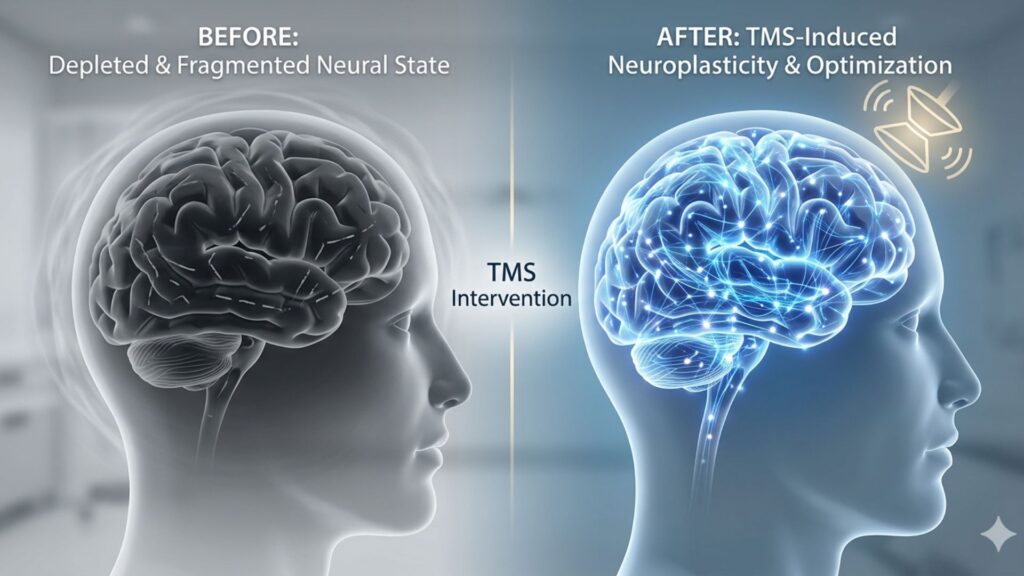
At the heart of transcranial magnetic stimulation (TMS) lies one of the brain’s most powerful abilities: neuroplasticity—the capacity of the brain to adapt, reorganize, and form new connections in response to experience, learning, or stimulation. TMS harnesses this natural capability to create lasting therapeutic changes in mood, behavior, and cognition. Rather than acting like a quick chemical fix, TMS stimulates the brain’s own ability to rewire itself.
Neuroplasticity is the brain’s lifelong ability to change. It allows us to learn new skills, recover from brain injury, and adjust to new circumstances. This adaptability occurs at several levels. On the cellular level, neurons can strengthen or weaken their connections, known as synaptic plasticity. Structurally, neurons can grow new branches or change the shape of existing ones. Functionally, entire regions of the brain can shift roles to compensate for damage or dysfunction. In mental health, this kind of flexibility is especially important because many psychiatric conditions stem from overly rigid or dysfunctional brain networks.
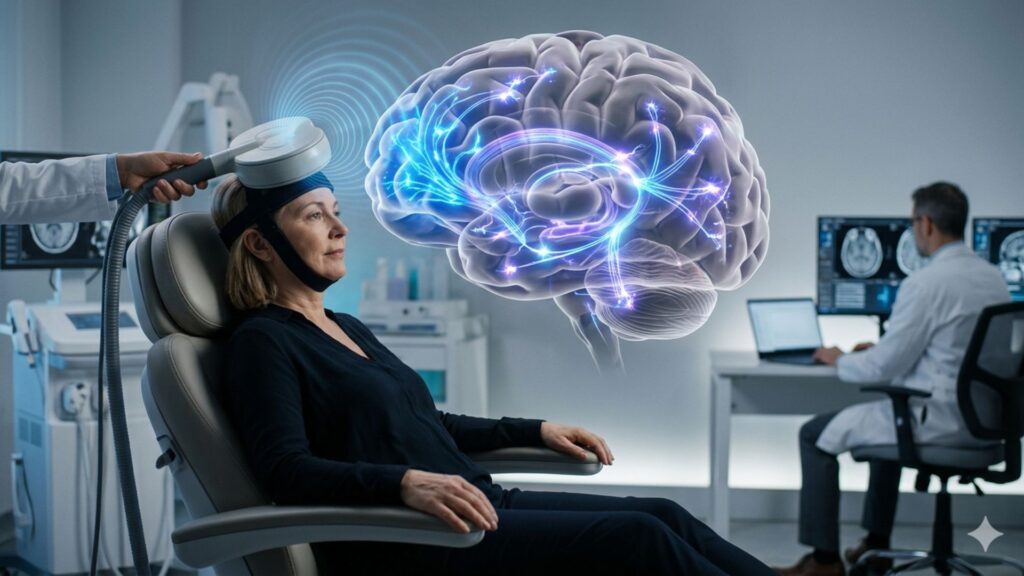
TMS interacts with these mechanisms by delivering focused magnetic pulses to specific areas of the brain. These pulses create small electrical currents that activate nearby neurons. When this process is repeated over many sessions—a protocol known as repetitive TMS (rTMS)—it can lead to changes in how those neurons connect and communicate with other parts of the brain. This is how TMS promotes long-term potentiation (LTP), which strengthens neural connections, and long-term depression (LTD), which weakens overactive or unhelpful patterns. In the context of mental health, LTP and LTD represent the brain’s potential to “reset” circuits responsible for mood, anxiety, and thought patterns.
Numerous studies support the idea that TMS stimulates neuroplastic change. EEG recordings have shown that after TMS treatment, brain wave patterns become more synchronized in the targeted networks. MRI scans have detected increases in the volume of brain regions like the prefrontal cortex following a full course of TMS in people with depression. Animal research also supports these effects, with experiments demonstrating that TMS can increase the density of dendritic spines—small structures that help neurons communicate—and boost levels of neurotransmitters like dopamine and serotonin.
Neuroplasticity is particularly relevant to understanding why TMS works so well for conditions like depression, PTSD, OCD, and anxiety. For example, depression is associated with decreased activity and reduced connectivity in areas such as the dorsolateral prefrontal cortex and the hippocampus. These regions play critical roles in mood regulation and memory processing. When TMS is applied to the prefrontal cortex, it not only increases activity in that area but also re-engages deeper brain regions through connected circuits. This cascade of effects helps restore emotional regulation and cognitive flexibility—hallmarks of improved mental health.
In PTSD, brain networks associated with fear and threat response can become overactive, leading to hypervigilance, intrusive memories, and emotional numbing. TMS helps reduce this hyperconnectivity by damping down activity in the right prefrontal cortex and altering how the brain processes threat-related stimuli. This allows patients to regain a sense of safety and emotional control. Similarly, in OCD, overactivity in the orbitofrontal cortex and basal ganglia contributes to intrusive thoughts and compulsive behaviors. TMS can reduce this overactivity and promote more adaptive thought patterns, offering relief even when medications or therapy alone have not succeeded.
Crucially, the effects of TMS don’t disappear when treatment ends. Because TMS works by promoting neuroplasticity, its impact continues to unfold in the weeks and months that follow. Brain circuits that have been reactivated or reorganized begin to operate more efficiently. This is why many patients report continued improvement after finishing their treatment course. In some cases, booster sessions or maintenance TMS may be recommended to reinforce these changes, especially for chronic or treatment-resistant conditions.
Enhancing TMS outcomes involves more than just turning on the machine. Many experts now recommend integrating other plasticity-enhancing strategies to support and amplify the effects of stimulation. Cognitive behavioral therapy (CBT), when paired with TMS, can help “train” the brain to adopt new habits and thinking styles while it’s in a more receptive state. Physical exercise increases blood flow and boosts levels of brain-derived neurotrophic factor (BDNF), a molecule that supports neuron growth and connectivity. Mindfulness practices and meditation have also been shown to alter brain structure and function, making the brain more resilient and adaptable. Nutritional support, including omega-3 fatty acids and antioxidant-rich foods, provides the building blocks needed for healthy brain remodeling.
By combining these interventions with TMS, clinicians can take full advantage of the brain’s capacity to change. This synergy between stimulation and lifestyle can turn a short-term improvement into a lasting transformation.
In summary, neuroplasticity isn’t just a buzzword—it’s the biological engine that drives the success of TMS. By tapping into the brain’s inherent ability to change itself, TMS doesn’t merely suppress symptoms. It helps reshape the very networks that cause those symptoms in the first place. As we continue to explore new technologies and treatment protocols, the future of TMS lies in maximizing its power to promote long-term, meaningful brain change.
References
- Cirillo, G., Di Pino, G., Capone, F., et al. (2017). Neurobiological after-effects of non-invasive brain stimulation. Brain Stimulation, 10(1), 1–18. https://doi.org/10.1016/j.brs.2016.11.009
- Guerra, A., Asci F., et all (2020). Gamma-transcranial alternating current stimulation and theta-burst stimulation: inter-subject variability and the role of BDNF,Clinical Neurophysiology,Volume 131, Issue 11,2020,Pages 2691-2699,ISSN 1388-2457, https://doi.org/10.1016/j.clinph.2020.08.017.
- Philip, N. S., Barredo, J., van ‘t Veer, A., et al. (2018). Network mechanisms of clinical response to transcranial magnetic stimulation in depression and the role of neuroplasticity. Neuropsychopharmacology, 43(1), 239–247. https://pubmed.ncbi.nlm.nih.gov/28886760/
Ridding, M. C., & Ziemann, U. (2010). Determinants of the induction of cortical plasticity by non-invasive brain stimulation in healthy subjects. Journal of Physiology, 588(13), 2291–2304. https://doi.org/10.1113/jphysiol.2010.190314