
How TMS Works on the Brain Part 10:Long-Term Impacts of TMS on Brain Function
One of the most compelling reasons for choosing transcranial magnetic stimulation (TMS) is its potential to offer long-term relief. Unlike medications that must be taken daily and often lose effectiveness over time, TMS helps the brain reorganize and function more effectively well beyond the treatment window. For many patients, the positive changes brought about by TMS persist for months or even years.
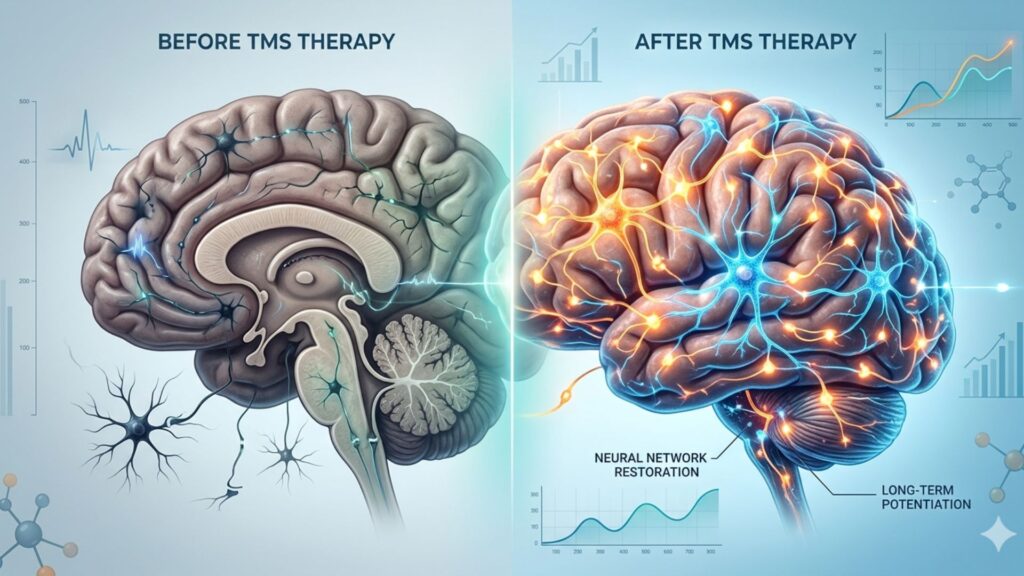
The long-term impacts of TMS are closely linked to how it promotes neuroplasticity, the brain’s ability to rewire itself in response to stimulation. Repeated sessions of TMS don’t just alter brain activity during treatment—they set off a cascade of adaptive changes that continue afterward. These changes affect both the structure and function of neural networks, creating more balanced and efficient communication between brain regions.
Sustained Symptom Relief
Clinical studies have shown that individuals who respond to TMS—especially those with major depressive disorder (MDD)—often maintain their improvement long after completing treatment. Follow-up data from multiple trials indicate that about 60-70% of responders continue to feel better at three months, and nearly half still report benefits at the six-month mark without additional therapy.
For those who do experience a return of symptoms, a brief course of maintenance TMS or “booster” sessions can help restore improvement. While insurance providers often do not cover these maintenance treatments, many TMS clinics offer their own discounted packages or pay-per-session plans to make continued care more accessible for patients. In contrast to restarting a full round of medication or trying a new drug altogether, this option is non-invasive and often well tolerated.
Brain Network Reorganization
TMS targets specific cortical areas like the dorsolateral prefrontal cortex (DLPFC), but its effects ripple through entire brain networks. Functional imaging studies using fMRI and EEG have revealed that TMS helps restore more normalized patterns of connectivity across regions involved in emotion regulation, attention, and cognitive control.
Along with the DLPFC–sgACC pathway, recent findings have highlighted improvements in the default mode network (DMN), salience network, and executive control network. These systems govern key functions such as self-awareness, focus, and adaptive decision-making. The default mode network (DMN) is active during rest and introspective thinking, and it’s often overactive in conditions like depression. The salience network helps detect and prioritize important stimuli, playing a crucial role in emotional regulation and switching between mental states. The executive control network is responsible for goal-oriented behavior, problem-solving, and maintaining attention on tasks. In individuals with depression, for example, TMS has been shown to reduce overactivity in the DMN—particularly in areas linked with rumination—while enhancing functional connections that support task engagement and emotional regulation.
These network-level shifts in connectivity often persist after treatment, suggesting that TMS induces long-term recalibration of the brain’s communication systems. Such lasting modulation may explain the durable improvements in symptoms and cognitive functioning experienced by many patients.
Structural Brain Changes
Beyond functional improvements, TMS has also been shown to influence the physical structure of the brain. MRI studies have documented increased gray matter volume in areas targeted by TMS, including the prefrontal cortex and hippocampus. These changes mirror those seen with successful antidepressant treatment and psychotherapy, reinforcing the idea that TMS drives real biological healing—not just temporary symptom suppression.
In addition to mood disorders, similar structural changes have been observed in patients treated for conditions like OCD, PTSD, and even chronic pain. This points to a broader capacity of TMS to enhance brain resilience across multiple psychiatric and neurological domains
Cognitive and Emotional Benefits
TMS doesn’t just lift mood—it can improve broader aspects of brain performance. Patients often report clearer thinking, better concentration, improved sleep, and enhanced emotional stability. Some of these effects likely result from restored balance in the DMN, salience network, and executive control network—three large-scale systems involved in introspection, attention, and emotional regulation.
In fact, emerging research suggests that TMS may have neuroprotective effects in aging populations and those at risk of cognitive decline. By improving network efficiency and supporting neuroplasticity, TMS may help preserve cognitive function in addition to treating active symptoms.
Real-World Functioning
Perhaps most importantly, the benefits of TMS extend into daily life. Patients who have undergone successful TMS treatment often experience improved relationships, increased productivity, and greater motivation to engage in work or hobbies. Because TMS addresses the root of cognitive and emotional dysfunction, it empowers individuals to regain a sense of autonomy and well-being.
This long-lasting functional recovery sets TMS apart from many other treatments that require ongoing compliance or produce diminishing returns over time. With proper follow-up and a personalized care plan, TMS can serve as a launchpad for lifelong mental health improvement.
Conclusion
The long-term impacts of TMS are not only promising—they are transformative. By enhancing connectivity, supporting structural brain changes, and promoting neuroplasticity, TMS creates a foundation for sustained recovery. As research continues to uncover more about how TMS shapes the brain, its role in the future of mental health care is set to expand, offering patients a non-invasive, enduring path to healing.
References
- Dunlop, K., Woodside, B., & Downar, J. (2016). Targeting neural endophenotypes of eating disorders with non-invasive brain stimulation. Frontiers in Neuroscience, 10, 17. https://pmc.ncbi.nlm.nih.gov/articles/PMC4754427/
- Caulfield, K. A., Brown, J. C., & George, M. S. (2022). The problem and potential of TMS’ infinite parameter space: A targeted review and roadmap forward. Frontiers in Psychiatry, 13, 867091. https://doi.org/10.3389/fpsyt.2022.867091
- Liston, C., Chen, A. C., Zebley, B. D., et al. (2014). Default mode network mechanisms of transcranial magnetic stimulation in depression. Biological Psychiatry, 76(7), 517–526. https://doi.org/10.1016/j.biopsych.2014.01.023
Boes, A. D., Uitermarkt, B. D., Albazron, F. M., et al. (2018). Rostral anterior cingulate cortex is a structural correlate of repetitive TMS treatment response in depression. Brain Stimulation, 11(3), 575–581. https://pubmed.ncbi.nlm.nih.gov/29454551/