

How TMS Works on the Brain Part 12:How TMS Influences Emotional and Cognitive Processing
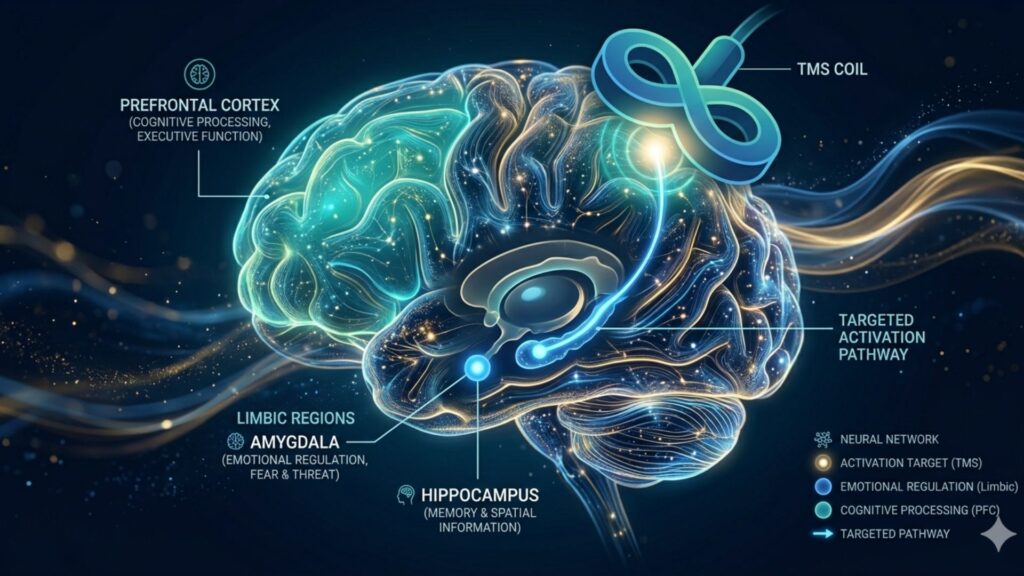
Transcranial magnetic stimulation (TMS) isn’t just about lifting depression or reducing anxiety—it also brings about significant changes in how people feel, think, and respond to the world. This is because TMS has a direct impact on the neural circuits responsible for emotional regulation and cognitive function. By modulating brain activity in targeted regions, TMS can improve everything from memory and decision-making to emotional balance and impulse control.
Emotional Regulation and the Brain
Emotions are regulated by a complex network of brain regions, particularly those that make up the limbic system—including the amygdala, hippocampus, and anterior cingulate cortex (ACC). These structures interact closely with the prefrontal cortex, which acts like the brain’s control center, helping to manage reactions to emotional stimuli.
When someone struggles with depression, anxiety, PTSD, or other mood disorders, this network often becomes dysregulated. The prefrontal cortex may be underactive, while the amygdala becomes overactive, leading to heightened emotional reactivity, difficulty calming down, and negative thought loops. TMS helps correct these imbalances by increasing activity in the prefrontal cortex and restoring more adaptive communication across the emotional network.
For example, stimulating the left dorsolateral prefrontal cortex (DLPFC) with high-frequency TMS has been shown to reduce emotional blunting and improve positive affect in individuals with depression. On the other hand, low-frequency stimulation of the right DLPFC can calm hyperactivity linked with excessive worry and panic, offering relief to those with anxiety disorders.
Neuroimaging studies confirm that TMS reduces activity in the amygdala and increases connectivity between prefrontal regions and deeper emotional centers. This rebalancing allows patients to process emotions more flexibly, respond more calmly to stressors, and experience a greater sense of emotional stability.
Cognitive Improvements Beyond Mood
TMS is equally impactful when it comes to cognitive processing. Patients frequently report improvements in memory, attention, executive functioning, and decision-making. These gains are not merely side effects—they are core outcomes of targeting brain circuits involved in thinking and learning.
High-frequency TMS applied to the left dorsolateral prefrontal cortex (DLPFC) has been particularly effective in enhancing working memory, a foundational cognitive function responsible for holding and manipulating information. This can improve everyday tasks like planning, organizing, and multitasking. In clinical populations, improvements in processing speed and verbal fluency have also been noted, allowing patients to think and communicate more effectively.
TMS also appears to benefit neurocognitive efficiency, or how quickly and accurately the brain can process and respond to information. Functional MRI studies have shown decreased activity in irrelevant brain regions during cognitive tasks following TMS—suggesting more focused, efficient brain performance. This is especially useful in conditions such as ADHD, where attentional control is compromised, and in PTSD, where hyperarousal and distractibility can interfere with concentration.
Moreover, early evidence suggests that repetitive TMS may stimulate neurogenesis and enhance synaptic plasticity, processes that support learning and memory formation. In older adults and those with mild cognitive impairment (MCI), TMS has shown promise in preserving cognitive abilities and possibly delaying the progression of degenerative diseases.
Beyond clinical populations, healthy individuals undergoing TMS for research purposes have also demonstrated short-term enhancements in attention, memory consolidation, and cognitive flexibility—indicating that the technology holds potential as a broader tool for brain optimization.
TMS to the prefrontal cortex, for example, can enhance working memory, which is critical for holding and manipulating information in real-time. Improved function in the anterior cingulate and executive control networks also contributes to better focus, error detection, and goal-directed behavior.
These effects are especially relevant in conditions like ADHD, PTSD, and mild cognitive impairment, where deficits in attention and executive function are prominent. In some cases, TMS may even promote cognitive resilience and slow the progression of age-related cognitive decline.
Integrating Emotional and Cognitive Gains
While emotional and cognitive changes are often discussed separately, they are deeply interconnected. Emotional dysregulation can impair attention and problem-solving, while poor cognitive control can make it harder to manage emotional reactions. TMS helps address both sides of this equation by improving the neural balance that supports emotional-cognitive integration.
Patients often describe feeling not only happier but also more “clear-headed” or mentally sharp. This clarity makes it easier to engage in therapy, build healthier habits, and navigate social and professional responsibilities. In many ways, the improvements in emotional and cognitive function amplify one another—contributing to deeper, more lasting recovery.
Looking Ahead
As researchers continue to explore the broader applications of TMS, new protocols are being developed to target specific emotional and cognitive processes. This includes theta burst stimulation (TBS) for rapid symptom relief, and personalized mapping to focus on the unique circuitry involved in each patient’s challenges. Combined with neuroimaging and real-time EEG monitoring, future TMS sessions may become even more tailored to each person’s cognitive-emotional profile.
Conclusion
TMS doesn’t just treat symptoms—it reshapes how the brain processes thoughts and emotions. By improving the connectivity and function of key brain networks, TMS empowers patients to feel more balanced, focused, and in control of their mental health. As both a clinical tool and a window into the brain’s potential, TMS continues to redefine what’s possible in emotional and cognitive healing.
References
- Koenigs, M., & Grafman, J. (2009). The functional neuroanatomy of depression: Distinct roles for ventromedial and dorsolateral prefrontal cortex. Behavioural Brain Research, 201(2), 239–243. https://doi.org/10.1016/j.bbr.2009.03.004
- Luber, B., & Lisanby, S. H. (2014). Enhancement of human cognitive performance using transcranial magnetic stimulation (TMS). NeuroImage, 85, 961–970. https://doi.org/10.1016/j.neuroimage.2013.06.007
- Bai, S., Dokos, S., Ho, K. A., & Loo, C. (2014). A computational modelling study of transcranial magnetic stimulation on neural tissue. Brain Stimulation, 7(3), 466–470. https://www.ncbi.nlm.nih.gov/books/NBK562096/
Philip, N. S., Barredo, J., Aiken, E., & Carpenter, L. L. (2018). Neuroimaging mechanisms of therapeutic transcranial magnetic stimulation for major depressive disorder. Biological Psychiatry: Cognitive Neuroscience and Neuroimaging, 3(3), 211–222. https://doi.org/10.1016/j.bpsc.2017.10.007
Locations
Choose the office that’s most convenient for you. Our Chesterfield and Richmond Heights locations are here to provide accessible, patient-focused care in a welcoming and professional environment.
CHESTERFIELD
112 Chesterfield Commons East Rd.
Chesterfield, MO 63005
314-697-4867
RICHMOND HEIGHTS
1505 S Big Bend Blvd,
Richmond Heights, MO 63117
314-384-1006

