
How TMS Works on the Brain Part 4:High-Frequency TMS vs. Low-Frequency TMS
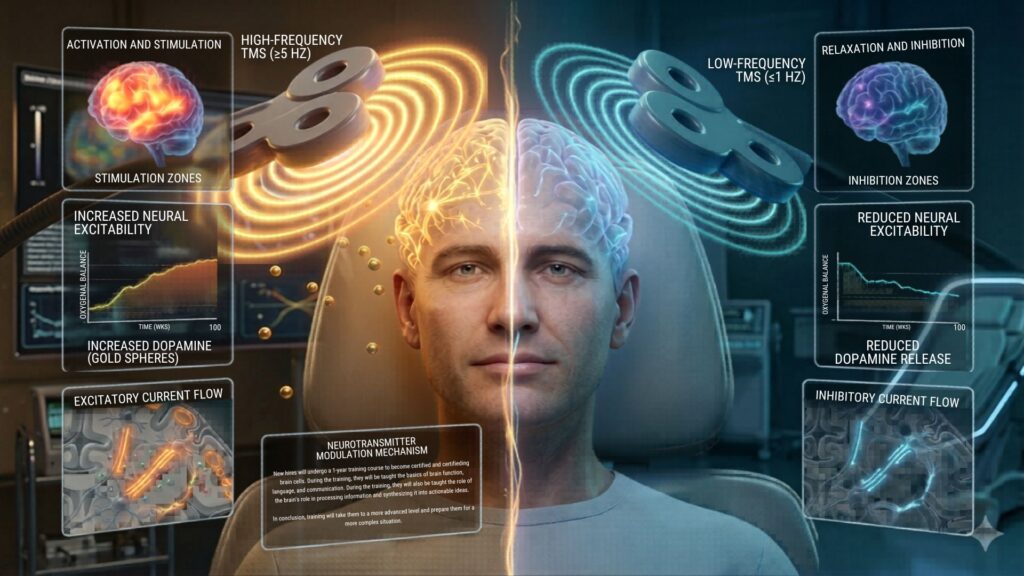
One of the defining features of transcranial magnetic stimulation (TMS) is its versatility. By simply adjusting the frequency of stimulation, clinicians can either excite or inhibit specific brain regions. This ability to fine-tune brain activity makes TMS especially effective in treating a wide variety of neurological and psychiatric conditions.
In clinical practice and research, two frequency ranges are most commonly used. High-frequency TMS (≥5 Hz) tends to increase neuronal excitability and activity. It is often used to activate underactive brain areas, such as the left dorsolateral prefrontal cortex (DLPFC) in patients with depression. Low-frequency TMS (≤1 Hz), on the other hand, has an inhibitory effect, dampening overactive neural circuits. This makes it effective for conditions like anxiety, PTSD, and tinnitus, where reducing hyperactivity in certain brain regions can alleviate symptoms.
These outcomes arise from the stimulation’s impact on synaptic plasticity—the brain’s ability to strengthen or weaken neural connections based on experience. High-frequency stimulation can promote long-term potentiation (LTP), enhancing synaptic strength, while low-frequency stimulation supports long-term depression (LTD), reducing synaptic transmission.
Clinical Applications and Use Cases
High-frequency TMS is widely used for mood disorders, particularly major depressive disorder (MDD). Stimulation of the left DLPFC has been shown to boost connectivity with deeper limbic structures involved in emotional regulation. This same approach is being investigated in other areas, including:
– Addressing negative symptoms of schizophrenia – Enhancing cognitive function and working memory – Promoting motor recovery in stroke rehabilitation by stimulating regions near the damaged motor cortex
Low-frequency TMS is commonly used to suppress excessive neural activity. By targeting the right DLPFC, clinicians can help reduce emotional overactivation in anxiety-related conditions. It is also applied in cases such as:
– Generalized anxiety disorder (GAD) and panic disorder – Obsessive-compulsive disorder (OCD), especially when paired with cognitive-behavioral therapy – Auditory hallucinations in schizophrenia by modulating the left temporoparietal cortex – Post-traumatic stress disorder (PTSD), where calming overactive circuits supports emotional processing
This low-frequency approach is typically well tolerated and carries a reduced risk of adverse effects, making it an appealing option for more sensitive or treatment-resistant individuals.
The Role of Theta Burst Stimulation
A more recent advancement in TMS protocol design is theta burst stimulation (TBS), which compresses the benefits of traditional TMS into shorter, more efficient sessions. TBS uses bursts of high-frequency pulses delivered in a theta rhythm, a pattern observed in natural brain activity. It comes in two primary forms:
– Intermittent TBS (iTBS), which increases cortical excitability and mimics the effects of high-frequency TMS – Continuous TBS (cTBS), which decreases activity and parallels the impact of low-frequency stimulation
Sessions using TBS typically last between 3 to 10 minutes. Research suggests they can produce outcomes comparable to, or in some cases even better than, conventional TMS protocols. iTBS has already received FDA approval for depression, and ongoing studies are exploring its potential applications in conditions like OCD, PTSD, and cognitive enhancement.
Personalized Frequency Selection
Choosing between high- and low-frequency TMS depends on the patient’s clinical profile, including their symptoms, diagnosis, and neurological state. Advanced imaging tools such as functional MRI and EEG help guide treatment planning, along with the patient’s treatment history. For example:
– A patient with treatment-resistant depression may benefit from excitatory high-frequency stimulation targeting the left DLPFC. – Someone with panic or anxiety disorders might respond better to inhibitory low-frequency TMS over the right prefrontal cortex. – In stroke recovery, clinicians may apply high-frequency TMS to the affected hemisphere and low-frequency TMS to the non-affected side to rebalance brain activity.
The use of neuronavigation systems and individualized protocols ensures that treatment is not only effective but also finely tuned to the patient’s unique brain structure and needs.
Conclusion
The contrast between high- and low-frequency TMS highlights the strength of this technique—its adaptability. Whether aiming to increase, suppress, or stabilize brain activity, TMS offers flexible, evidence-based strategies for promoting neural balance and improving patient outcomes. As technology advances and protocols continue to evolve, personalized frequency selection will be an essential part of future mental health care.
References
- Blumberger, D. M., Vila-Rodriguez, F., Thorpe, K. E., et al. (2018). Effectiveness of theta burst versus high-frequency repetitive transcranial magnetic stimulation in patients with depression (THREE-D): A randomized non-inferiority trial. The Lancet, 391(10131), 1683-1692. https://doi.org/10.1016/S0140-6736(18)30295-2
- Lefaucheur, J. P., Aleman, A., Baeken, C., et al. (2020). Evidence-based guidelines on the therapeutic use of repetitive transcranial magnetic stimulation (rTMS). Clinical Neurophysiology, 131(2), 474-528. https://doi.org/10.1016/j.clinph.2019.11.002
- Temel, Y., Hescham, S. A., Jahanshahi, A., Janssen, M. L., Tan, S. K., van Overbeeke, J. J., Ackermans, L., Oosterloo, M., Duits, A., Leentjens, A. F., & Lim, L. (2012). Neuromodulation in psychiatric disorders. International review of neurobiology, 107, 283–314. https://doi.org/10.1016/B978-0-12-404706-8.00015-2
- Chung, S. W., Hoy, K. E., & Fitzgerald, P. B. (2015). Theta-burst stimulation: A new form of TMS treatment for depression? Depression and Anxiety, 32(3), 182-192. https://doi.org/10.1002/da.22335