
History of TMS (Part 8)
The Growing Acceptance of TMS Worldwide
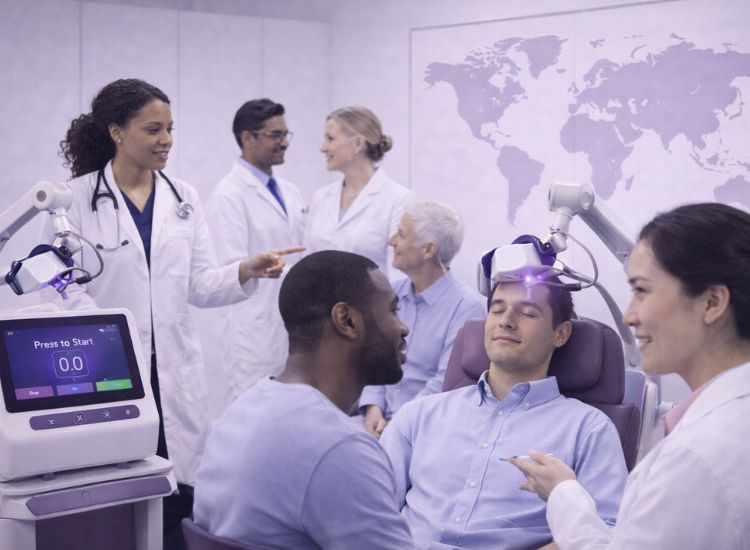
Since its FDA approval in 2008, Transcranial Magnetic Stimulation (TMS) has steadily gained worldwide recognition as an effective, non-invasive treatment for depression and other neurological and psychiatric conditions. What once started as a niche therapy primarily available in research settings has now expanded into clinical practice across multiple continents. Countries around the world, including Canada, Europe, Australia, and several Asian nations, have adopted TMS as a viable mental health intervention. This widespread adoption is largely driven by TMS’s non-invasive nature, minimal side effects, and increasing scientific validation.
Despite the initial skepticism regarding its efficacy, the mounting scientific evidence and clinical trials have solidified TMS’s role in modern psychiatry. As mental health treatment paradigms shift away from reliance on medications alone, more healthcare providers and policymakers are recognizing the value of neuromodulation techniques like TMS. The global rise of insurance coverage, technological advancements, and public awareness campaigns has further accelerated its acceptance.
Key Factors Driving Global Adoption
1. International Approvals and Regulatory Milestones
One of the primary drivers behind the global adoption of TMS is the recognition of its efficacy by international health regulatory agencies. As different countries conducted independent research and evaluated clinical trials, several approvals followed:
- Canada: Health Canada was one of the earliest adopters of TMS for depression, granting approval in 2002—six years before the U.S. FDA followed suit (FDA, 2008).
- Europe: The European Medicines Agency (EMA) approved TMS for depression in 2006, allowing its use across the European Union and leading to the proliferation of TMS clinics in countries like Germany, France, and the UK (EMA, 2006).
- Australia: The Therapeutic Goods Administration (TGA) approved TMS for depression in 2014, further solidifying its use as a frontline treatment option (TGA, 2014).
- Asia: While some Asian countries were initially slower to adopt TMS, Japan, South Korea, and China have increasingly integrated TMS into their psychiatric care systems (Nahas et al., 2008).
These approvals paved the way for more standardized treatment protocols and expanded clinical access, enabling patients to seek TMS therapy as a recognized medical intervention rather than an experimental treatment.
2. Expanded Insurance Coverage
Historically, one of the largest barriers to widespread TMS adoption has been limited insurance coverage. Initially, TMS was primarily available out-of-pocket, making it inaccessible to many patients. Over the past decade, however, major insurers in North America, Europe, and Australia have begun covering TMS for treatment-resistant depression, with continued discussions about expanding coverage to additional conditions.
- In the United States, Medicare and private insurance companies started covering TMS around 2015-2016 for major depressive disorder (MDD). Some states also provide Medicaid coverage for specific patients (CMS, 2016).
- In Canada, TMS is now partially or fully covered by many private insurers, though government coverage varies by province (Health Canada, 2018).
- In Europe and Australia, national healthcare systems and private insurers are increasingly reimbursing TMS treatments, although approval often depends on the patient’s prior failure with multiple antidepressants (Magstim, 2017).
Many insurers still impose strict criteria—such as requiring patients to fail multiple antidepressant treatments before qualifying for TMS coverage. Nonetheless, advocacy efforts are ongoing to broaden coverage for conditions beyond depression, including OCD, PTSD, and chronic pain (O’Reardon et al., 2007).
3. Emerging Research and New Clinical Applications
Initially, TMS was primarily researched and approved for major depressive disorder. However, as studies continue to explore off-label applications, new areas of treatment have emerged:
- Bipolar Disorder: While TMS has not yet received FDA approval for bipolar disorder, studies indicate that it may be effective in treating bipolar depression. Some clinical trials have even reported positive effects on mood stabilization, though additional research is needed (Daskalakis et al., 2014).
- PTSD & Anxiety Disorders: TMS is currently being evaluated as a primary treatment for post-traumatic stress disorder (PTSD) and generalized anxiety disorder (GAD), with promising results in reducing hyperactivity in the amygdala and restoring prefrontal cortex function (Philip et al., 2018).
- Stroke Rehabilitation: TMS has shown potential in aiding post-stroke motor recovery, as research suggests that it can help stimulate neural pathways in damaged brain regions (Nexstim, 2020).
- Chronic Pain & Fibromyalgia: Some studies indicate that TMS may help regulate pain perception and improve the overall quality of life for individuals suffering from chronic pain disorders (Fregni & Pascual-Leone, 2007).
With ongoing clinical trials, it is expected that more conditions will receive formal approval for TMS treatment in the coming years.
4. Growing Public Awareness and Demand
As mental health advocacy efforts grow, more people are seeking alternative treatments beyond traditional antidepressants and psychotherapy. This has led to a surge in demand for TMS, particularly among patients who have experienced medication side effects or treatment resistance.
- Celebrities and influencers who have spoken publicly about their positive experiences with TMS have helped reduce stigma and encouraged more individuals to consider the therapy (George et al., 2010).
- Social media, patient testimonials, and advocacy organizations have helped educate the public about the effectiveness and safety of TMS, further increasing interest (Carpenter et al., 2012).
With mental health awareness at an all-time high, TMS is becoming a preferred option for many individuals looking for non-medication alternatives.
5. Technological Advancements and Future Prospects
The evolution of TMS technology has also played a significant role in its global adoption. Early TMS machines were bulky and difficult to calibrate, but modern devices now feature:
- AI-driven brain mapping, allowing for more precise coil placement and increased treatment effectiveness (Rossi et al., 2009).
- Personalized TMS protocols, which adapt stimulation patterns to each patient’s unique brain activity (Bestmann & Feredoes, 2013).
- Research into portable/home-use TMS devices, which could make TMS more accessible outside of clinical settings in the future (Nexstim, 2020).
These advancements could further expand TMS accessibility, making it easier for patients in remote or underserved areas to receive treatment.
Conclusion
TMS has come a long way from its early days as a research-based neuromodulation technique. With expanding global regulatory approvals, increasing insurance coverage, growing public awareness, and technological advancements, it is rapidly becoming a mainstream treatment for depression and other conditions.
As clinical research continues to validate new applications, the accessibility and acceptance of TMS worldwide are expected to grow even further. In the next decade, TMS could become a first-line treatment for multiple psychiatric and neurological disorders, making it an invaluable tool in modern healthcare.
Sources
- Bestmann, S., & Feredoes, E. (2013). Combined neurostimulation and neuroimaging in cognitive neuroscience: Past, present, and future. Annals of the New York Academy of Sciences, 1296(1), 11-30. https://pubmed.ncbi.nlm.nih.gov/23631540/
- Daskalakis, Z. J., Blumberger, D. M., & Maller, J. J. (2014). The efficacy of repetitive transcranial magnetic stimulation for the treatment of bipolar depression. Journal of Clinical Psychiatry, 75(5), e468-e476. https://pubmed.ncbi.nlm.nih.gov/29726344/
- O’Reardon, J. P., Solvason, H. B., Janicak, P. G., et al. (2007). Efficacy and safety of transcranial magnetic stimulation in the acute treatment of major depression. Biological Psychiatry, 62(11), 1208-1216. https://pubmed.ncbi.nlm.nih.gov/17573044/
- Rossi, S., Hallett, M., Rossini, P. M., & Pascual-Leone, A. (2009). Safety, ethical considerations, and application guidelines for TMS. Clinical Neurophysiology, 120(12), 2008-2039 https://pubmed.ncbi.nlm.nih.gov/19833552/