
History of TMS (Part 2)
Anthony Barker’s Breakthrough in the 1980s (Expanded)
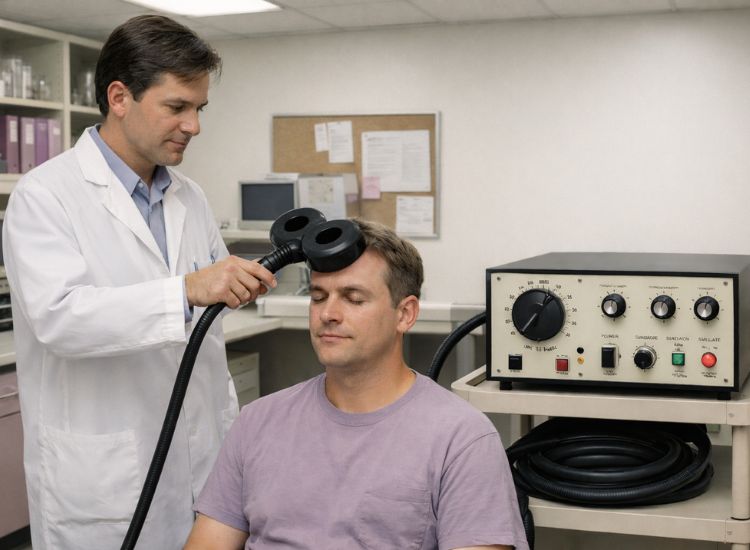
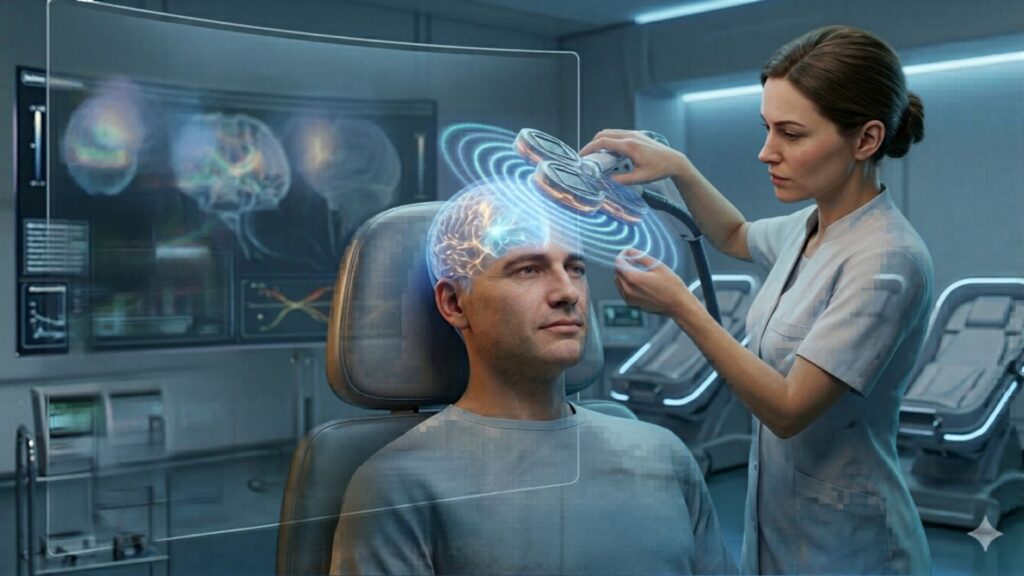
In 1985, Dr. Anthony T. Barker and his research team at the Department of Medical Physics, Royal Hallamshire Hospital, University of Sheffield introduced transcranial magnetic stimulation (TMS)—a groundbreaking method for non-invasive brain stimulation. This innovation marked a significant shift in neuroscience and neuromodulation, providing researchers and clinicians with a safe, precise, and painless way to stimulate the brain without surgery or direct electrical contact.
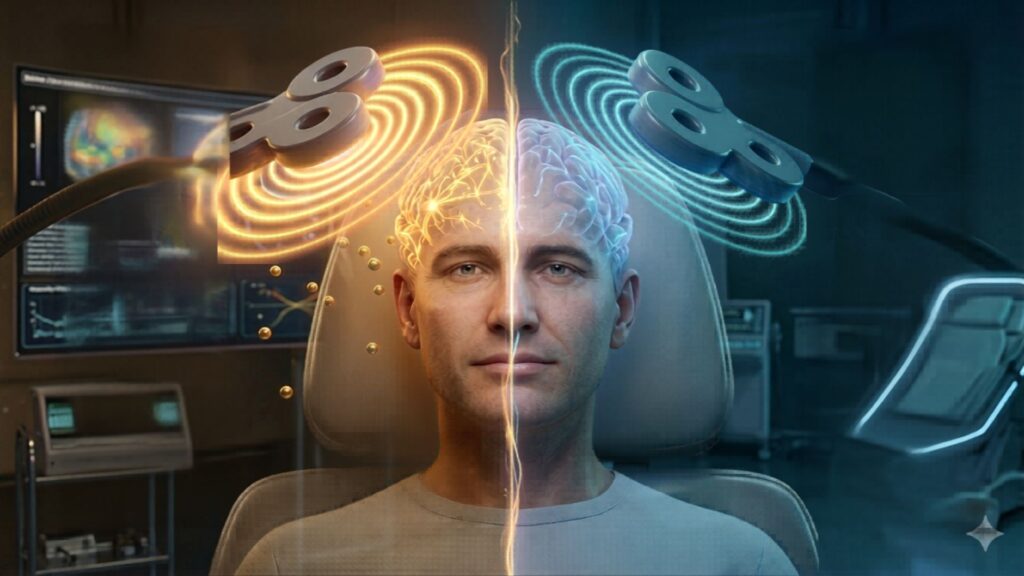
Barker’s development of TMS was the culmination of years of research into the interaction between electromagnetic fields and biological tissues. His goal was to develop a technology that could modulate brain activity without the risks associated with direct electrical stimulation. Using electromagnetic induction principles first described by Michael Faraday in 1831, Barker and his colleagues built the first TMS device, demonstrating that magnetic fields could penetrate the skull and induce an electric current in the brain, leading to functional activation of neural pathways.
The Research That Led to Barker’s Discovery
Before inventing TMS, Barker was heavily involved in electromagnetic field research, particularly in understanding how magnetic fields interact with biological tissues and the nervous system. The focus of his work in the early 1980s was to overcome the limitations of direct electrical stimulation, which required electrodes to be placed either on the scalp or directly inside the brain.
Barker and his team specifically investigated how strong magnetic fields could generate electric currents inside neural tissue. They were inspired by earlier studies showing that externally applied magnetic fields could influence peripheral nerves and muscle contractions. However, no prior study had successfully applied this principle to the human central nervous system.
Their research involved extensive trials on animal models before transitioning to human experiments. They carefully studied:
- The shape and intensity of the induced currents in brain tissue.
- How different magnetic coil designs affected stimulation depth and spread.
- Whether stimulation could be delivered repeatedly without causing harm to neurons.
Using advanced computer modeling and neurophysiological testing, they optimized their device to ensure it could produce controlled, localized stimulation of the brain’s cortex without heating tissue or causing discomfort.
The First Successful Human TMS Experiment
Barker and his team’s first major success with human TMS occurred in 1985. Using their newly developed magnetic stimulation coil, they positioned it over a subject’s motor cortex, the brain region responsible for voluntary movement. Upon activating the device, the coil emitted a rapid magnetic pulse, which passed through the skull and induced an electric current in the cortical neurons beneath it.
The result was a visible twitch in the subject’s hand—proving for the first time that magnetic fields could safely and effectively stimulate brain activity without direct electrical contact.
This experiment, published in The Lancet (Barker, Jalinous, & Freeston, 1985), marked the first successful non-invasive brain stimulation of a human being using electromagnetism. It demonstrated that:
- Magnetic pulses could penetrate the skull without resistance.
- Electrical currents could be induced in neurons without external electrodes.
- Brain activity could be modulated in a targeted and controlled manner.
This experiment provided strong neurophysiological evidence that TMS could be a powerful research tool for mapping brain function and exploring neural connectivity.
Overcoming Challenges in TMS Development
Developing TMS was not without significant challenges. Some of the technical obstacles Barker’s team had to overcome included:
- Generating a magnetic field strong enough to affect cortical neurons.
- Early prototypes produced weak magnetic pulses that failed to induce noticeable effects. Barker and his team had to increase the coil’s power output while ensuring safety.
- Designing an efficient coil to maximize brain penetration.
- They experimented with various coil shapes, eventually settling on circular and figure-eight coils, which could concentrate the magnetic field over a specific brain region.
- Ensuring safety and repeatability of stimulation.
- They conducted systematic studies to determine whether repeated stimulation had any harmful effects, particularly regarding seizure risk and long-term neural changes.
Barker’s meticulous engineering and safety testing laid the groundwork for TMS to evolve into a widely accepted scientific and clinical tool.
Barker’s Decision Not to Patent TMS
One of the most crucial decisions Barker made was choosing not to patent TMS technology. This meant that any researcher or institution could develop their own TMS systems without needing a licensing agreement or paying royalties.
As a result:
- TMS research exploded worldwide, with institutions in the U.S., Europe, and Asia quickly adopting and improving the technology.
- Advancements in TMS coil design and stimulation protocols occurred much faster than if it had been controlled by a single company or institution.
- The first clinical trials of TMS for psychiatric disorders emerged by the early 1990s, setting the stage for its future medical applications.
Barker’s open-source approach to innovation ensured that TMS remained an accessible tool for neuroscience, rather than a commercialized product restricted by intellectual property laws.
The Immediate Impact of Barker’s Discovery
Barker’s successful demonstration of TMS had far-reaching implications for neuroscience and clinical medicine:
- Brain Mapping and Neurophysiology:
- Scientists could now use TMS to map brain function in real time, identifying the roles of different cortical regions in movement, perception, and cognition.
- Neuroplasticity and Learning:
- Early studies using TMS provided key insights into how the brain adapts and reorganizes itself, paving the way for future treatments targeting stroke recovery and neurorehabilitation.
- Mental Health Applications:
- While initially a research tool, Barker’s invention quickly attracted interest for treating psychiatric disorders, particularly major depressive disorder (MDD).
- Non-Invasive Treatment Potential:
- Unlike ECT, which required sedation and caused memory loss, TMS offered a gentler, more targeted way to influence brain activity.
Recognition of Barker’s Contributions
Dr. Barker’s contributions have been widely recognized over the years:
- In 2015, he received the first-ever International Brain Stimulation Award for his pioneering work in TMS development.
- In 2017, he published a reflection on the impact of his discovery, highlighting how TMS had transitioned from an experimental tool into an established clinical treatment (Barker, 2017).
- His work continues to influence modern neuroscience, neurology, and psychiatry, as TMS remains one of the most important tools for studying and treating the human brain.
Conclusion: The Lasting Impact of Barker’s Discovery
Dr. Anthony Barker’s invention of transcranial magnetic stimulation (TMS) in 1985 was a landmark achievement in neuroscience. His pioneering research, coupled with his commitment to open collaboration, allowed TMS to develop rapidly into a widely used tool for brain research and treatment.
Today, TMS remains one of the most promising neuromodulation techniques, with ongoing research exploring its potential in psychiatry, neurology, and neurorehabilitation. Thanks to Barker’s vision and ingenuity, millions of people worldwide now benefit from non-invasive brain stimulation technologies that were once considered impossible.
Sources:
- Barker, A. T., Jalinous, R., & Freeston, I. L. (1985). Non-invasive magnetic stimulation of human motor cortex. The Lancet, 1(8437), 1106-1107. https://pubmed.ncbi.nlm.nih.gov/2860322/
- Barker, A. T. (1999). The history and basic principles of magnetic nerve stimulation. Electroencephalography and Clinical Neurophysiology Supplement, 51, 3-21. https://pubmed.ncbi.nlm.nih.gov/10590990/
- Hallett, M. (2000). Transcranial magnetic stimulation and the human brain. Nature, 406(6792), 147-150. https://www.nature.com/articles/35018000
- Dr. Anthony T. Barker Wins First International Brain Stimulation Award. (2015). Brain Stimulation Journal. Dr. Anthony Baker Wins First International Brain Stimulation Award